Hair Restoration in Palm Beach County – Frequently Asked Questions
Is FUT still a common procedure?
Yes. Follicular Unit Transplantation (FUT), aka the “strip” technique, remains an excellent choice for patients with significant hair loss who desire dense coverage and long-lasting results. During your consultation, Dr. Ramani will help you explore each option to determine if FUT is appropriate for you.
Will I have a visible scar?
Following FUT hair restoration surgery, a fine linear scar remains in the donor area, but Dr. Ramani’s precise closure technique and your natural hair will conceal it completely. After FUE hair restoration, tiny, dot-like scars are scattered throughout the donor area.
Is FUT or FUE hair restoration painful?
Both FUE and FUT are performed under local anesthesia, so patients experience minimal discomfort during the procedure itself. Most patients report only mild soreness in the donor and recipient areas for a few days following their hair restoration procedure. This discomfort is easily managed with prescribed or over-the-counter pain medication – Dr. Ramani will discuss your options during your consultation. Recovery is generally well-tolerated, with many patients returning to work within a few days.
How long does recovery take after FUE compared to FUT?
Recovery from FUE is relatively quick compared to FUT, with most patients able to return to work within 3 to 5 days, depending on their job. FUT incisions typically heal in 10 to 14 days. However, no matter which option you undergo, strenuous exercise and activities that cause excessive sweating should be avoided for about two weeks to ensure optimal healing and graft survival.
Does FUT provide permanent results?
Yes. The transplanted hair is permanent and continues to grow naturally for life.
Does FUE leave visible scarring?
Unlike FUT, which leaves a linear scar across the donor area, FUE leaves tiny, dot-like scars scattered throughout the donor area rather than a linear scar, making them virtually undetectable even with very short haircuts. Dr. Ramani uses advanced techniques to help your incisions heal and to help minimize your scars.
Can FUT and FUE be combined?
Yes. Dr. Ramani can use a hybrid approach, combining both techniques for optimal density and coverage while preserving donor area integrity.
When will I see results from my hair restoration procedure?
Transplanted hair typically sheds within 2 to 3 weeks after the procedure, which is a normal part of the process as the follicles enter a resting phase. New hair growth usually begins around 3 to 4 months post-procedure, with noticeable improvement by 6 months and final results visible in 12 to 18 months. Patience is key following hair restoration, as the transplanted follicles need time to establish blood supply and produce strong, healthy hair.
Am I a good candidate for hair restoration?
Ideal candidates for hair restoration are in good overall health, have realistic expectations, and possess sufficient donor hair in areas like the back and sides of the scalp. Hair transplantation works best for those with pattern baldness, thinning crowns, or receding hairlines who have stable hair loss. During your consultation, Dr. Ramani will evaluate your hair loss pattern, donor hair quality, scalp condition, and aesthetic goals to determine which treatment approach – surgical or non-surgical – will deliver the best results for your unique situation.
What is the difference between FUE and FUT hair restoration?
FUT (follicular unit transplantation) involves removing a strip of scalp from the donor area, from which individual follicular units are dissected and transplanted, allowing for 2,000 to 4,000+ grafts in a single session. FUE (follicular unit extraction) harvests individual follicles one at a time using a small punch tool, typically yielding 1,000 to 2,500 grafts per session. FUT leaves a linear scar that can be concealed by surrounding hair, while FUE creates tiny dot-like scars that are virtually undetectable even with short haircuts. Dr. Ramani will help you choose the method that best suits your hair loss extent, lifestyle, and aesthetic preferences.
What topical solutions are available for hair loss?
Topical treatments like minoxidil (Rogaine) can slow hair loss and stimulate regrowth in some patients, particularly those with early-stage thinning or diffuse hair loss. These FDA-approved medications work by prolonging the growth phase of hair follicles and increasing blood flow to the scalp. While topical solutions can be effective for maintaining existing hair and promoting modest regrowth, they require consistent daily application, and results vary by individual. Dr. Ramani often recommends combining topical treatments with hair transplantation for comprehensive, long-lasting results.
Can topical treatments replace the need for hair transplant surgery?
Topical treatments can help slow the progression of hair loss and may stimulate some regrowth, but they typically cannot restore significant volume or coverage in areas with advanced hair loss. Hair transplantation offers permanent results by relocating healthy follicles to thinning or bald areas, while topical solutions require ongoing use to maintain benefits. Many patients achieve optimal outcomes by combining surgical hair restoration with topical treatments. The transplant restores lost density while topical medications help preserve remaining native hair and support transplanted follicles.
How long does a hair restoration procedure take?
The duration of your hair restoration procedure depends on the technique used and the number of grafts being transplanted. FUE procedures typically take 4 to 8 hours, depending on the graft count, as each follicle is individually extracted and placed. FUT procedures may take 4 to 6 hours, as the strip method allows for more efficient harvesting. Dr. Ramani and her team work meticulously to ensure precise placement and natural-looking results, and patients are made comfortable throughout the procedure with local anesthesia and sedation options.
What is recovery like after hair transplantation?
Recovery varies slightly between FUE and FUT procedures. FUE patients typically experience minimal discomfort and can return to work within 3 to 5 days, with tiny extraction sites healing within a week. FUT patients may need 10 to 14 days before returning to normal activities, as the linear incision requires slightly more healing time. Strenuous exercise should be avoided for 2 to 3 weeks for either hair transplantation option. Both procedures involve some swelling, crusting, and mild discomfort in the first week. Dr. Ramani will provide detailed post-operative instructions and medications to ensure a smooth recovery.
When will I see results from my hair transplant?
Hair restoration requires patience, as transplanted follicles go through a natural growth cycle. Most transplanted hair will shed within 2 to 3 weeks, which is normal and expected. New growth typically begins around 3 to 4 months post-procedure, with noticeable improvement visible by 6 months. Final results, including full density and length, develop over 12 to 18 months as all transplanted follicles mature and produce healthy hair. Dr. Ramani will monitor your progress throughout this timeline to ensure optimal outcomes.
Will my hair transplant look natural?
When performed by an experienced surgeon like Dr. Ramani, hair transplantation delivers virtually undetectable and exceptionally natural-looking results. Dr. Ramani strategically designs your hairline to complement your facial features and age, precisely places grafts to mimic natural hair growth patterns, and varies graft sizes throughout different zones for authentic density and texture. The transplanted follicles are your own hair, so they grow, can be cut, styled, and colored just like the rest of your hair.
Can women benefit from hair restoration procedures?
Absolutely. Women experiencing pattern hair loss, thinning crowns, widening parts, or hair loss due to traction, scarring, or medical conditions can be excellent candidates for hair restoration. Dr. Ramani specializes in addressing female hair loss patterns, which often differ from male baldness and require a customized approach. She may recommend FUE for targeted areas, combination treatments with topical medications, or PRP therapy, depending on the cause and extent of your hair loss.
Are hair transplant results permanent?
Yes, hair transplantation provides permanent results because the transplanted follicles are genetically resistant to the hormone DHT (dihydrotestosterone) that causes pattern baldness. Once transplanted to thinning or bald areas, these follicles continue growing for a lifetime. However, it’s important to understand that native hair in untreated areas may continue to thin over time due to ongoing genetic hair loss. Dr. Ramani may recommend maintenance treatments or topical solutions to preserve your remaining natural hair and protect your investment.
How much does hair restoration cost?
The cost of hair restoration varies based on the technique used (FUE or FUT), the number of grafts required, and the complexity of your case. During your consultation, Dr. Ramani will assess your hair loss pattern, discuss your goals, and provide a personalized treatment plan with transparent pricing. While hair transplantation is typically not covered by insurance as it’s considered cosmetic, financing options are available to make treatment accessible and affordable.
Can hair restoration be combined with other treatments?
Yes, Dr. Ramani often recommends a comprehensive approach to hair restoration that combines multiple treatments for optimal results. Hair transplantation can be enhanced with PRP (platelet-rich plasma) therapy to improve graft survival and stimulate existing follicles, topical medications like minoxidil to maintain native hair, or low-level laser therapy to promote scalp health. This multi-modal approach addresses hair loss from multiple angles and maximizes both immediate transplant results and long-term hair preservation.
Meet Dr. Ramani
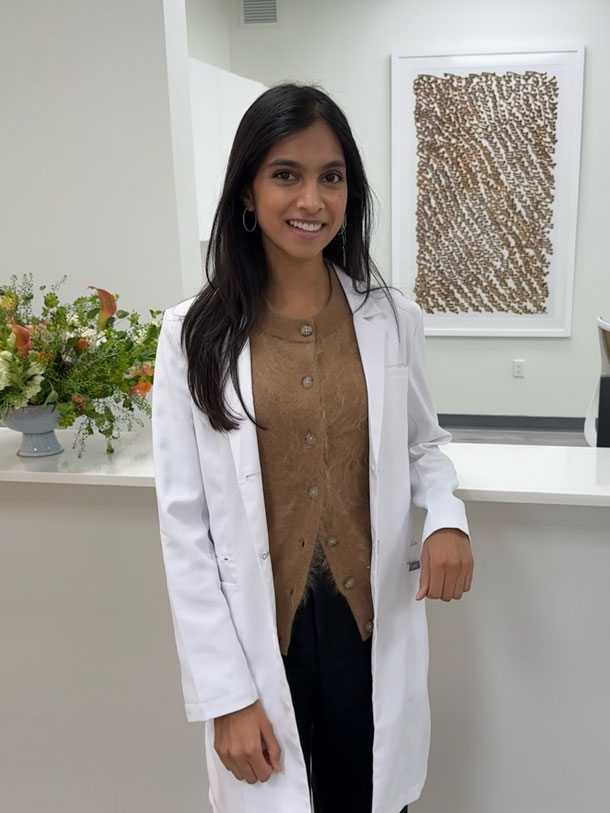
Experience elevated dermatologic care with Dr. Leena Ramani, a board-certified dermatologist and fellowship-trained hair transplant surgeon serving Palm Beach County. Known for her artistic eye and advanced expertise in both skin and hair restoration, Dr. Ramani blends evidence-based medicine with a refined aesthetic approach to deliver natural, timeless results.
Whether you’re seeking treatment for hair loss, skin conditions, or cosmetic enhancements, her patient-centered philosophy ensures personalized care in a calm, luxurious setting. Schedule your consultation today to discover how expert dermatology and artistry come together to help you look and feel your most confident.